
Grade Deflation at Princeton
An attempt to solve a coordination problem

There was a lot of discussion about grade inflation this semester, which made me think about Princeton’s grade deflation policy from 2004. But I quickly realized that I didn’t know any of the details, so I read a few articles; this post summarizes my findings.
The proposal
In February 1998, the Faculty Committee on Examinations and Standing at Princeton University called for faculty to take “collective responsibility for halting grade inflation and grade compression at Princeton.” And in April 2004, Dean of the College Nancy Malkiel presented a proposal for a common grading standard across the university: each department should award less than 35% A-range grades (i.e., A-, A, and A+) for undergraduate courses (and less than 55% A-range grades for independent work).1 At the time, among the Ivy League, Stanford, MIT, and the University of Chicago, the percentage of A-grades ranged from 44 to 55, with two institutions in the 45-46 range, four (including Princeton) in the 47-48 range, and three in the 49-51 range.
Dean Malkiel provided some motivation:
“By adopting [these proposals], the faculty will be better able to give students the carefully calibrated assessment they deserve of the quality of their course work and independent work,” Malkiel wrote in a cover memo. “The proposed grading standard responds to the desire of the department chairs that all departments be asked to meet common expectations. It responds to the desire of students for evenhandedness in grading across the departments. And it positions Princeton to take national leadership in tackling what has seemed an intractable national problem.”
The proposal included testimonials from medical schools, law schools, fellowship administrators, and employers. Most were reportedly supportive and claimed that the proposal “would not compromise the futures of Princeton students and, in some cases, would be looked upon favorably.”
Dean Malkiel also wrote, “Because no single department has any incentive to act unilaterally to address grade inflation, the chairs reasoned, the provision of a University-wide grading standard that all departments must observe will make it possible for all departments to cooperate.” In other words, if curbing grade inflation is a collective action problem among departments, then the policy was Princeton’s attempt at a solution.
A few weeks after the proposal was released, the faculty of Princeton adopted an amended version that included an “expectation” of 35% A’s, rather than the originally proposed “limit.”
The Good News
The good news, for Dean Malkiel and other proponents of the proposal, is that the percentage of A-grades decreased from 46.0 in 2003-04 (and 47.9 in 2002-03) to 40.9 in 2004-05. A breakdown by division is below:
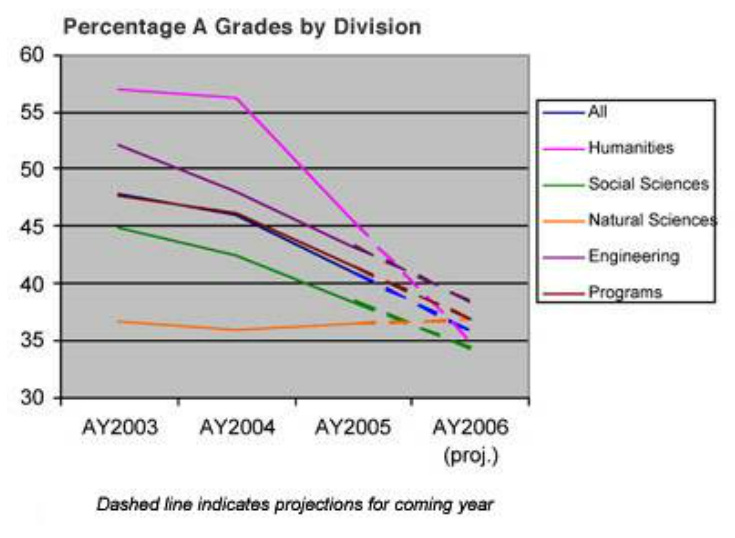
Dean Malkiel seemed pleased: “Many departments are at or very close to the desired standards; in others, while there is more work to be done, the progress made in a very short time has been nothing short of remarkable. Culture change is hard to achieve, and we always imagined that it would take several years to implement the new grading expectations. We are clearly on our way.”
In 2008-09, the percentage of A-grades fell to 39.7; this was the first time it fell below 40 since the policy was approved. Dean Malkiel still seemed pleased: “The Princeton faculty continues to make successful progress in its determined effort to restore educational content and meaning to the letter grades earned by the highest-achieving students in the United States.”
The Bad News
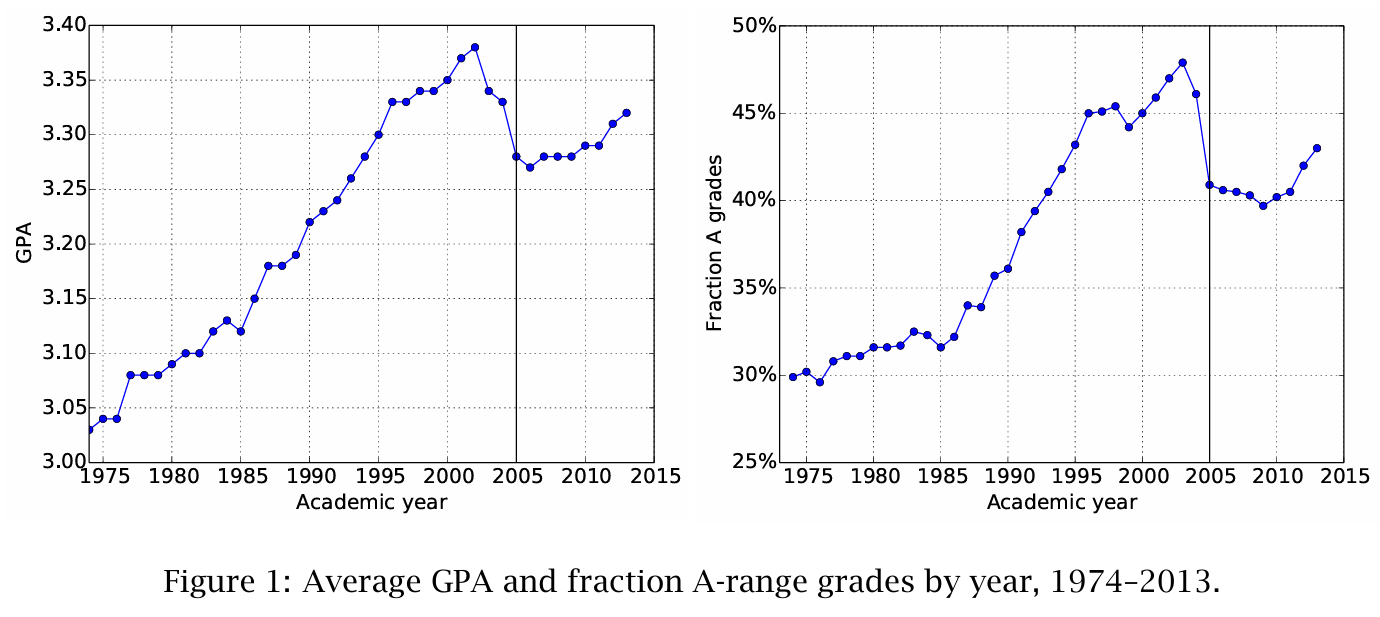
Unfortunately (for proponents of the proposal), the percentage of A-grades hovered around 40 for about five years, and between 2009 and 2013, it increased by 3.3 percentage points, according to a report released by a Princeton committee in 2014.
The report originates from October 2013, when Princeton University President Christopher L. Eisgruber charged an ad hoc committee with reviewing the policies on grading. More specifically, he asked the committee to consider evidence for how the policy has affected students (e.g., employment, graduate school admissions) and whether the benefits can be achieved “with less emphasis on numerical targets.”
In August 2014, that committee released a 35-page report (35 — what a coincidence!) that recommends removing numerical targets from the grading policy. One reason it gives is that trying “to maintain ‘fair and consistent’ grading standards across academic departments” is “not appropriate” because standards and grades are not the same thing:
Standards are the evaluative rubrics departments and instructors develop to convey to students the specific expectations for their work and against which that work will be graded. Grades measure the extent to which students meet those expectations. “Consistent standards” is an admirable goal in the abstract, but in practice it is our judgment that it is difficult if not impossible to compare standards across departments in different fields… Thus we have come to feel strongly that departments should spend their time developing clear and meaningful evaluative rubrics for work within their disciplines rather than aligning grades to meet specific numeric targets.
In a similar vein, the report criticizes the goal of achieving uniformity in A-grades across departments as “not a reliable measure of fairness across departments” because departments that teach large-enrollment, 100-200 level courses can achieve the 35% goal simply by reducing the percentage of A-grades in those courses, while departments without large courses must reduce the percentage of A-grades in their 300-400 level courses.
The report also points out that average GPA and percentage of A-grades both declined a year before the policy began (see Figure 1 above) and speculates as follows:
A reasonable interpretation is that this decline was due to conversations the dean of the college was having with departments about grade inflation, which resulted in an increase in general awareness of grading policy among the faculty… We suggest that this sort of continuing conversation is a more effective and positive way of having an appropriate grading policy, and with fewer undesirable side effects, than setting numerical targets… The emphasis should move away from “grades,” and instead focus on “quality of feedback.”
More details from the report
In February and March 2014, students were surveyed about the grading policy, and the report summarizes the results by stating that among undergraduates (~45% response rate), “a majority indicated support for the goals of the grading policy, but expressed strongly negative views on the policy’s implementation, effectiveness, and influence on their academic experience at Princeton.” It includes one student’s response about a professor changing a 91 on an exam to an 88, and another about a professor who announced that only 3 of the 11 students in a class would receive A’s. Students criticized the policy for incentivizing competition and even sabotage, and they blamed it for negatively impacting their futures with respect to medical school admissions and scholarships.
Faculty sentiment (~50% response rate) was “roughly equal on both sides of the question,” though “the humanists were more strongly opposed to the policy than were the natural scientists.” And public sentiment (primarily alumni/parents) was “strongly in favor of the goals of the grading policy, but there was an almost equally strong belief that it has been ineffective.”
Near the end, the report discusses the committee’s attempts at independently studying the side effects of the 35% policy along four dimensions:
“Anxiety among the students”: The committee “received no hard evidence with which to substantiate absolutely that student anxiety has increased as a direct result of the grading policy,” but they “did receive considerable evidence to support the argument, unsurprisingly, that grades, anxiety about grades, and students’ sense of psychological well-being (or lack thereof) are closely related.”
“Competitiveness outside Princeton”: “As far as graduate school is concerned, it is not evident that Princeton’s grading policy has any effect.” Regarding medical school specifically, the committee was presented with “evidence that our grading policy does not measurably affect our students’ frankly remarkable success.” Similarly, the authors of the report did not find compelling evidence to support the idea that the grading policy was meaningfully reducing students’ chances at fellowships or jobs. (One exception was ROTC, which ranks students nationally based on their GPA and other factors.)
“Admissions yield”: The authors of the report heard that “prospective students and their parents see the numerical targets as inflexible” and “removing the numerical targets would go a long way towards alleviating these concerns.” Also, “[c]oaches find the perception of the grading policy a significant obstacle to recruitment, making it more difficult for them to attract the best student-athletes to Princeton.”
“Impact on freshmen”: The report considers the potential impact of the grading policy on freshmen in particular: “Arguably, part of the ‘culture shock’ in coming to Princeton is that the average GPA for freshmen is 3.24, a value significantly lower than what most students earned in high school.” The authors considered pass/fail grading for freshmen, but recognized potential complications and concluded “that the issue was beyond the scope of the committee.”
On October 6, 2014, the faculty removed the target of 35% A-grades.
The Situation Today
A Princeton report on AY 2024-2025 from earlier this month states the following:
In 2005, 39.3% of course grades were A-range (A- through A+); twenty years later, 66.7% of course grades land within the A-range. Even in introductory 100-200 level classes — where one might expect to see a broader distribution of grades — 62.6% of grades last year were A-range; only in Division III (the natural sciences) do fewer than 50% of the grades in introductory courses fall within the A-range. In more specialized 300-400 level classes across all four divisions, the percentage of A-range grades has climbed to 71.7%.
And here’s a chart with more details:
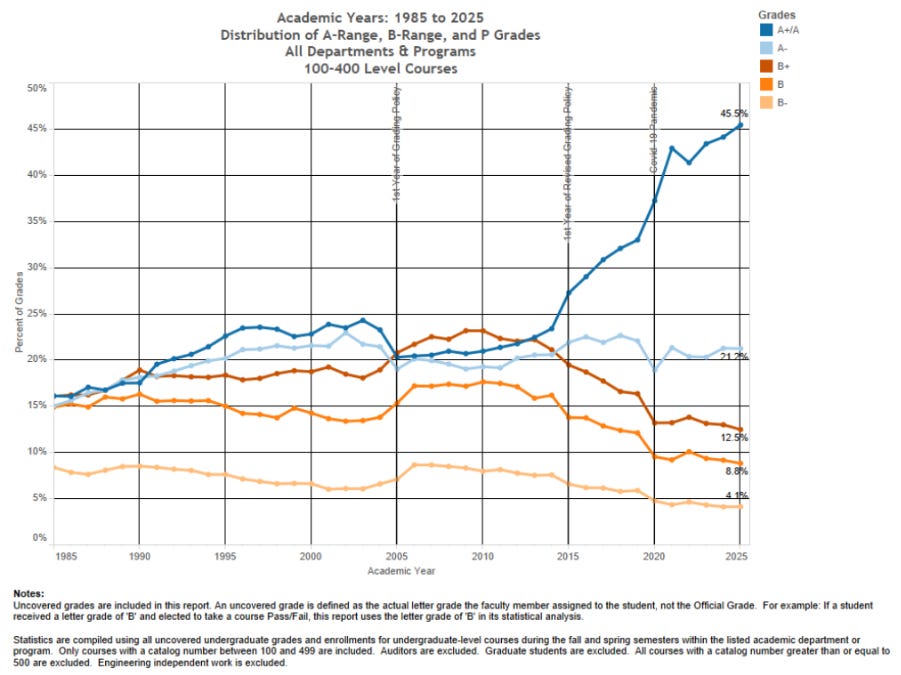
The report does not directly express concern about the percentage of A-grades; it mostly focuses on reducing the percentage of A+ grades. For context:
While the GPA and percentage of A-range grades are higher in Division I (the humanities) and Division II (the social sciences), A+ grades are more commonly given in Division III (natural sciences) and Division IV (engineering). This is especially true in upper-level STEM courses: in 300-400 level courses, A+ made up 4.7% of engineering grades and 6.5% of natural sciences grades. Among upper-level humanities courses only 2.9% of grades are A+, compared to 3.5% of upper-level social science course grades.
The report suggests that this difference exists because some faculty “feel strongly that given the number of A-range grades that are awarded in our current context, the A+ is a necessary tool to differentiate performance.” It then essentially accuses them of violating the Princeton “Rules and Procedures of the Faculty,” which state that the A+ “should be regarded as an exceptional grade reserved for work of extraordinary merit.” More specifically, it states (and underlines) the following: “faculty practice does not currently reflect the stated policy.”
In response to what it sees as unacceptably high percentages of A+ grades, the report states that the College has removed A+ from the default grading scale on Canvas, and it implicitly endorses the idea of having department chairs approve A+ grades. If the percentage of A+ grades continues to be a problem, maybe there should be a limit for each department…
I couldn’t find the original proposal itself; most of the information in this post is taken from other news articles and reports released by Princeton.